Playing a hand
How to call a tile in mahjong
You call a tile by claiming the newest discard before the next player draws, then laying it face up with your matching tiles. In American Mahjong you can only call to finish a group of three or more of the same tile, or for the very last tile that wins you the hand.
What does it mean to call a tile?
Every turn ends with a discard: one tile laid face up in the middle of the table and named out loud. The newest discard is called the live tile. If it’s a tile you need, you can claim it. That’s calling.
You can call a discard from any player at the table, not only the one before you. But you don’t have long. A live tile can be called only until the next player draws from the wall, the rows of face-down tiles everyone draws from. After that it’s dead, and no one can take it for the rest of the hand.
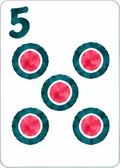
- The player on your right throws a 5 Crak. It’s live. (Bams, Craks and Dots are the three suits of number tiles.)
- You may call it now, if it finishes a group you need.
- The player across from you draws from the wall. Now the 5 Crak is dead. No one can call it.
Pung, kong and quint: the groups you can call for
An ordinary call always finishes a group of three or more identical tiles. Each size has a name.
| Group | Tiles | You hold | You call |
|---|---|---|---|
| Pung | 3 of a kind | 2 | the 3rd |
| Kong | 4 of a kind | 3 | the 4th |
| Quint | 5 of a kind | 4 | the 5th |
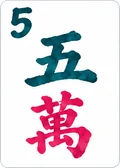
The tiles from your rack (the stand that holds your tiles) don’t all have to be real. Jokers from your rack can fill in the group you call for. A joker can stand in for any tile in a group of three or more of the same tile.
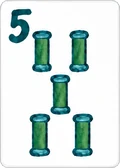

The tile counts set one more rule. There are only four of each number, wind and dragon, so a quint always needs at least one joker. Flowers are the exception. There are eight of them, and any flower matches any other, so a quint of flowers needs no joker.
Six of a kind is a sextet. It’s rare, and you’ll mostly see it with flowers.
Can you call a tile for a pair?
Not normally. You can’t call a discard to make a pair, a single tile, a run like 1 2 3, or one of each wind (written NEWS on the card). Only groups of three or more of the same tile can be called.
There’s one exception, and it matters. The tile that finishes your whole hand can always be called, whatever it completes: a pair, a single, a run or anything else. That’s calling for Mahjong. You call it, lay your whole hand face up for the table to check, and the hand is yours.
So there are two ways to win. You can draw the last tile yourself from the wall, or call it from someone’s discard.
How to call a tile, step by step
- Speak up while the tile is live. Call it before the next player draws.
- Take the discard from the middle of the table.
- Expose the group. Lay the called tile and your matching tiles, jokers included, face up in front of you on top of your rack, where everyone can see them.
- Don’t draw. The called tile was your draw for this turn.
- Throw one away. Discard a tile, just as you end any turn. Your discard is now the live tile.
- Play carries on to your right. The next turn belongs to the player on your right.
The group you call for has to be one your line needs. A line is one hand on this year’s card, the list of hands everyone at the table plays from. If you hold three tiles to go with the discard, you can make a kong instead of a pung. Choose the size your line asks for. Our guide to reading a mahjong card explains how lines are written.
How does calling change the turn order?
Normally play moves to the right, one player at a time. A call breaks that pattern. The turn jumps to whoever called. After the caller discards, play carries on to the caller’s right, and anyone in between misses that turn.
- You throw a 3 Dot. The player on your left needs it for a pung.
- She calls it. She exposes her pung, skips the draw and throws a tile.
- Then it’s your turn again. The players on your right and across were skipped this time round.
If the player whose turn was next anyway makes the call, nobody is skipped. She simply takes the discard instead of drawing from the wall. For the full rhythm of a turn, see how to play American Mahjong.
Who gets the tile if two people call it?
Sometimes two players want the same discard. Two rules settle it.
- A call for Mahjong beats every other call. If one player needs the tile to win, she gets it, even if another player has already reached for it to make a group, as long as the tile is still live.
- Otherwise, the next player in turn order wins. Between two calls of the same kind, the tile goes to the player whose turn would come first after the person who threw it.
It doesn’t matter who spoke fastest, or who is East (the dealer). Only these two rules count.
Exposed or concealed: should you call at all?
Every line on the card is marked with an X or a C.
- X (exposed): you may call discards to finish groups. Those groups go face up.
- C (concealed): you build the whole hand from your own draws. The only tile you may call is the very last one, for Mahjong.
An exposed group stays face up for the rest of the hand. You can’t take it back, break it up or turn it into a different group. And once you’ve exposed anything, concealed lines are off the table for you.
That makes every call a trade-off. Calling gets you tiles faster, but each exposed group tells the table what you’re building. Concealed lines are usually worth more points, because you can’t call your way there.
A call is usually worth it when
- The tile finishes a pung or kong your line needs
- Your line is marked X
- You’ve settled on one line
Better to let it go when
- Your best line is marked C
- You’re still choosing between lines
- The tile would give your plan away too early
Wrong exposures and dead hands
A hand is dead when it can no longer win. At a real table, these are the usual causes:
- Exposing a group that fits no line on the card
- Calling Mahjong with a hand that doesn’t match, often called a false Mahjong
- Holding the wrong number of tiles
A dead hand can’t win that round, but it only affects the player who made the mistake. Everyone else plays on. Tables differ on what the dead player does next, so ask yours. In Mahj Call, a dead hand keeps drawing and discarding but can no longer win.
Your exposures also limit later changes of plan. If you switch lines partway through a hand, the new line has to use the exact groups you’ve already exposed, at the same size.
How Mahj Call protects you
Mahj Call won’t let you make a call that leaves no line you can still finish. In practice hands, the Mahjong button appears only when your tiles truly match, so you can’t call a false Mahjong by accident.
At a real table, nobody stops you, so check your line twice before you call. When you’re ready to try it with people, find a mahjong table near you.
Questions
Can you call a tile for a pair in mahjong?
Not normally. In American Mahjong you can only call a discard to finish a group of three or more identical tiles: a pung, kong or quint. The one exception is the tile that finishes your whole hand. You can always call that one for Mahjong, even if it completes a pair or a single.
How long do you have to call a discarded tile?
Only while it’s live. The newest discard can be called until the next player draws from the wall. Once that draw happens, the tile is dead and stays dead for the rest of the hand. If you need a moment to decide, many players say “pause” before the next draw.
Do you draw a tile after you call a discard?
No. The called tile takes the place of your draw. Expose the group face up on your rack, then discard one tile to end your turn. Play then carries on to your right, so anyone whose turn came between the discarder and you misses a turn. If the tile wins you the hand, you lay out your hand instead.
Who gets the discard if two players call it?
A call for Mahjong always wins, even if someone else has already reached for the tile while it’s still live. If neither call is for Mahjong, or both are, the tile goes to the player whose turn comes first after the person who threw it. Speed and being East don’t matter.
Can you call a tile for a concealed hand?
Only for the win. A line marked C on the card must be built from your own draws, so you can’t call discards to make its groups. The one tile you may call is the very last one you need, for Mahjong. Once you’ve exposed any group, concealed lines are no longer possible.
Can you call a discarded joker?
No. A joker that has been discarded is dead the moment it lands. No one can call it, whether for a pung, a kong or Mahjong. It’s one more reason the usual advice is to hold on to your jokers: they’re the most useful tiles in the game.