Playing better
American Mahjong Strategy for Beginners
Good American Mahjong strategy starts before the first turn: find two or three lines your tiles already lean toward, keep every joker, and let the Charleston and the discards tell you which one to finish. Late in the hand, you add one more job: throwing safer tiles.
How do you choose a hand in American Mahjong?
You’re aiming for a line: one of the winning hands on this year’s card, the list your whole table plays from. The first to hold 14 tiles that match one line wins. So your first job is to find the lines your tiles already lean toward.
Look for clusters
When your tiles arrive, look for groups already started: pairs, pungs and numbers close together. A pung is three of the same tile. The tiles you hold more than one of are your best clue.
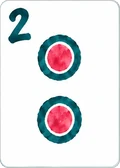
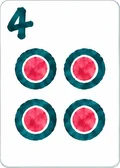
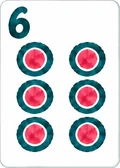
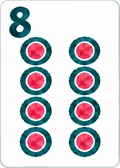




Here, a pair of 2 Dots and a pair of 6 Dots, with the 4 and 8 Dots close by, point toward a line of even numbers. Dots are one of the three suits, with Bams and Craks, and each runs from 1 to 9. The card groups its lines by theme, such as even numbers, odd numbers or numbers in a row. Our guide on how to read a mahjong card shows how to match tiles to a line.
Start with easier lines
Each line has a point value. While you’re learning, favor lines worth fewer points. They’re usually easier to finish, and a small win beats a big near miss. Lines that let you use any suit, or call discards, are friendlier than concealed ones.
Why keep two or three lines in mind?
Don’t settle too early. The Charleston and your first draws bring tiles you can’t predict, so keep two or three lines open and let the tiles decide.
Tiles worth keeping early
- Tiles that fit more than one of your lines.
- Jokers, always. They’re the most useful tiles in the game.
- Pairs. A pair can grow into a pung.
Know when to switch
If the tiles your line needs keep showing up in the discards, it’s fading. Switch to a backup while there’s still time to build it. The earlier you switch, the more turns you have.
How should you use jokers and count tiles?
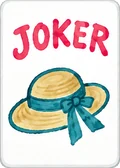
There are eight jokers. A joker can stand in for any tile in a group of three or more of the same tile: a pung, a kong (four) or a quint (five). It can never go in a pair, a single tile, a run of numbers or NEWS, which is one of each wind.
Count your jokers against each line
Count your jokers, then look at how many groups of three or more each line needs. A line built from pungs and kongs has room for your jokers. A line full of pairs and singles can’t use them, so you’ll need the real tiles. A quint always needs a joker, since there are only four of each tile, unless it’s flowers: there are eight.
Count what’s left
There are only four of each tile, and every one you see in the discards or face up on the table is one you can’t have.
A line that needs two more 6 Dots is in trouble: time to lean toward your backup.
Win jokers back from the table
On your turn, after you draw or call and before you throw, you can give the exact tile a joker stands for in any exposed group, your own included, and take the joker. No one can refuse.
What should you pass in the Charleston?
The Charleston is the tile trade before the first turn: three tiles right, across, then left. Your lines tell you what to pass.
Good tiles to pass
- Tiles that don’t fit any line you’re aiming for
- Lone tiles with nothing near them
- A suit you’ve decided not to collect
Better to keep
- Pairs and pungs you already hold
- Flowers, if your line uses them
- Tiles that fit two lines you’re choosing between
In the starting rack above, the lone North wind, 3 Bam, 5 Crak and 9 Crak fit least. Any three make a sensible first pass. Look again after every pass. If everyone agrees, the table may do a second Charleston, which runs the other way. Can’t spare three on the last pass of either Charleston? You may pass blind: send on some of the tiles coming to you without looking at them, so you still pass three in all. The full order is in our Charleston guide.
Should you expose tiles or stay concealed?
When another player throws a tile you need, you can call it to finish a group of three or more, then lay that group face up. That’s an exposure. You can call the newest discard only until the next player draws. Calling is faster, but every exposure tells the table what you’re building.
| Exposed | Concealed | |
|---|---|---|
| Speed | Faster: you can call discards | Slower: only your own draws count |
| Privacy | Everyone can see your groups | Nobody knows your plan |
Beside each line’s points is a C or an X. C means concealed: the only tile you may call is the very last one, for Mahjong. X lets you call discards to finish groups. Lines marked C are usually worth more points, because they’re harder to finish.
A call is usually worth it when
- The tile finishes a pung or kong your line needs
- Your line is marked X
- You’ve settled on one line

Better to let it go when
- Your best line is marked C
- You’re still choosing between lines
- The tile would give your plan away too early
An exposure stays face up for the rest of the hand and can’t be taken back. Once you have one, concealed lines are off the table. You can’t call a tile for a pair or a single unless it’s your last tile for Mahjong.
How do you read other players’ racks and discards?
You can’t see anyone’s rack, only the backs of their tiles. But everyone leaves clues.
- Exposed groups show what a player is building.
- Discards show what they don’t want. A suit someone keeps throwing is one they aren’t collecting.


Count what you can see, too: your own rack, the discards and everyone’s exposed groups. If three of a tile are showing, the fourth is the only one left.

Counting helps your own hand as much as your defense: it shows which lines are still realistic.
What are safe discards late in the hand?
Early on, build your hand and throw what you don’t need. Late in the hand, with a dozen or so tiles left in the wall (the face-down tiles everyone draws from), start thinking about safer discards. If the last tile is drawn and thrown and nobody has Mahjong, the hand ends with no winner: a wall game.
| Safer to throw | Riskier to throw |
|---|---|
| Tiles already thrown two or three times | Tiles that match someone’s exposed groups |
| Tiles nobody’s exposed groups could use | Tiles nobody has thrown yet, late in the hand |
A tile already thrown two or three times is usually safest, because fewer copies are left for anyone to use. With an opponent showing two groups of even Craks, any even Crak is a risky throw.
Defense isn’t giving up. You’re still building your own line, just choosing your throws with more care.
What mistakes do beginners make most?
- Settling on one line too soon. Keep two or three until the tiles decide.
- Throwing away a winning hand. After every draw you hold 14 tiles. Check for Mahjong before you discard.
- Calling too early. An exposure is for good. Call once you’ve settled.
- Chasing a fading line. If its tiles keep landing in the discards, switch.
- Calling Mahjong without checking. At a real table, a false Mahjong makes your hand dead for that round, though everyone else plays on. In Mahj Call practice hands, the Mahjong button appears only when your tiles truly match.
New to the game? Start with how to play American Mahjong, then find mahjong near you.
Questions
What is the best strategy for American Mahjong beginners?
Pick two or three lines your first tiles already lean toward, favor lines worth fewer points, and keep every joker. Pass tiles that fit none of your lines, switch when the tiles you need keep landing in the discards, and late in the hand, throw tiles already seen.
How do you choose a hand in mahjong?
Look for clusters in your first tiles: pairs, pungs and numbers that sit close together. The tiles you hold more than one of are your best clue. Find the theme they lean toward, such as even or odd numbers, then keep two or three lines open through the Charleston.
How many hands should you go for in mahjong?
Keep two or three lines in mind at the start, not one. The Charleston and your early draws bring tiles you can’t predict, so let them decide. Favor tiles that fit more than one line. Once you’ve settled on one, calling discards for it makes more sense.
Should you ever throw away a joker in mahjong?
Rarely, though the rules allow it. Jokers are the most useful tiles in the game, and a discarded joker is dead: no one can call it. You can’t pass one in the Charleston either. Jokers help least in a line of pairs and singles, because they only fill groups of three or more.
When should you expose tiles in mahjong?
Call and expose when the tile finishes a pung or kong your line needs, your line is marked X, and you’ve settled on one line. Wait when your best line is marked C or you’re still choosing. An exposed group stays face up for the rest of the hand and shows everyone what you’re building.
What is a safe discard in mahjong?
A safer discard is a tile already thrown two or three times, or one that nobody’s exposed groups could use. Riskier tiles match someone’s exposures or haven’t been seen yet late in the hand. No tile is completely safe, though: apart from a joker, which no one can call, any tile can be the last one someone needs for Mahjong.